Showing posts with label Greenland. Show all posts

Thursday, 29 November 2018

The Library of Ice: Reviews


It's one month since the publication of The Library of Ice, and I'm grateful that the book has received incredibly perceptive and positive reviews. My thanks to all the reviewers, and a special shout out to Patrick Barkham for selecting The Library of Ice as one of the Best Books of 2018 in the nature category in The Guardian. Here's a round up of reviews available online - click on the link to read in full.
  • "A refreshing lack of romanticism." Gavin Francis in The Guardian
  • "Campbell ... has invented a new kind of time-travel-writing. She is, unquestionably, one of our brightest stars." Horatio Clare in The Spectator
  • "At the end of her wanderings, which are simply but beautifully related, Ms Campbell returns to her few belongings in storage in London. Nothing much remains; treasures have broken; all is in flux, like the heaving, disappearing icebergs she has left behind, with their fragile cargo of human remains.' Anonymous, reviewed with Christopher Pinney's The Waterless Sea in The Economist
  • "An intellectual omnivore..." Barbara Kiser in Nature
  • "Campbell’s book puts a personal slant on the conservation of texts and languages, on the importance of saving both centuries of human endeavor and the landscapes that inspired them." Anna Souter in Hyperallergic
  • "In this journey, she has joined the dots between nations who don’t always recognise their primary interdependence." Sally Moss in ClimateCultures
  • "an essential read for anyone interested in the mutable, multi-faceted qualities of ice". Dani Redd in The Island Review

Wednesday, 24 January 2018

Objects for the Anthopocene


Last week ClimateCultures invited me to contribute an essay on three objects which might represent my personal timeline of the Anthropocene. You can read my watery selection here.

And for those curious for more on kayaks, over on the Waterlines blog you can read my first Canal Laureate poem.

Thursday, 13 April 2017

The Snowball

Now that A Book of Banished Words is published, I’ll conclude my posts about The Polar Tombola with the story behind the making of the ‘snowball’ which players picked their cards from during performances. (Thank you to everyone who took part!)

The drum holding these Greenlandic word cards was an obvious nod to the Italian tombolare that was the loose model for my game. So it ought to be round... but what else? As I began to design it I toyed with the idea of using a globe to reference languages around the world, because as The World Atlas of Languages in Danger demonstrates, language extinction is not a problem specific to the Arctic. But I soon discarded this idea in favour of something more snowy – evoking the traditional Inuit dwelling or iglu as well as childhood snowball fights.

 I visited the ceramics department of the Victoria and Albert Museum to source ideas. I started by studying how designers made tableware representing other objects, such as swans, snakes, cauliflowers and asparagus. (Please excuse the poor quality of the snaps below, they were never intended for publication.)


But the objects that appealed to me the most were simpler, in particular a beautiful porcelain moon jar by Park Young Sook (2006) – the refined clay with its translucent, flawless glaze seemed to evoke the same pristine beauty many people associate with the Arctic. Moon jars were used as ritual vessels in South Korea during the Chosun period. What was I embarking on, if not a ritual? I don’t want to reproduce my photo here because it doesn’t convey any of the awe I felt looking at the moon jar, but you can view it in the online V&A catalogue.

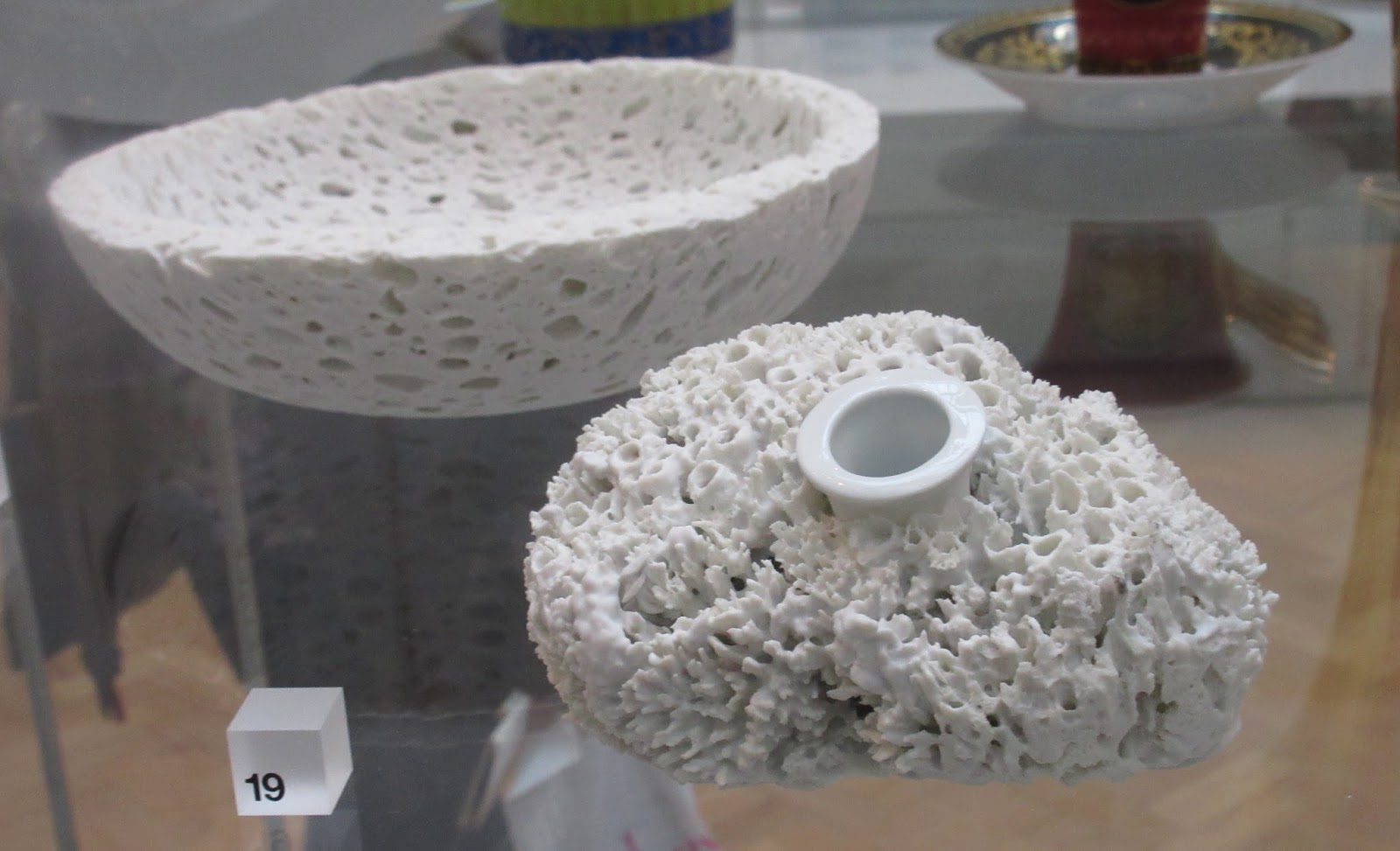
Knowing I’d never achieve the smooth perfection of Park Young Sook’s vessel, I started to look at other textures, such as...


... Egg Vase (above), Foam Bowl and Sponge Vase (below), designed by Marcel Waanders for Droog, in collaboration with Rosenthal. (Made by Moooi. Amsterdam, The Netherlands, 1997. Unglazed porcelain, cast from hard boiled eggs inside a condom, artificial foam and a natural sponge.)


... and Omenanlohko (made by Gunvor Olin-Grönqvist at Arabia, Helsinki, Finland, 1986. Glazed stoneware.)

Finally, I looked at ceramics that included text. Nushu (below, 2006) by Sara Radstone is an evocative series of stoneware slabs, painted with slip and grey stain. 


Nushu is a script used to write a local dialect of Chinese spoken in Jiangyong County in Hunan. It was used exclusively by women, and translates as ‘women’s writing’. It developed as a form of private communication, sometimes embroidered onto fabrics or written on fans. Radstone’s text, written lightly and upside-down across a series of book-like forms, reflects the clandestine nature of the script...

...and far less subtle, but just as fascinating, this piece of French tableware which wittily mixes verbal and visual signifiers.


I also loved this early nineteenth century gilded plate, with its bobbly enamel sea urchin that –entirely coincidentally – is not so very different in appearance from my own finished piece.

In the end I chose to use a material much less ambitious than ceramic, and closer to my usual medium: papier-mâché. The cause of my return to paper was spotting a work by Chun Kwang-young in the museum. Aggregation10-SE032RED (2010, below) is composed of many hundreds of pieces of Styrofoam, individually wrapped in pages of books printed on hanji paper. Hanji has multiple uses in Korea – including wrapping household objects for storage. The surface this work is full of cracks and imperfections, and you can’t make out the original meaning of the texts. The curator writes: ‘These complex defects symbolise the difficult history of Korea, but the strong paper reflects the resilience of the Korean people.’ 


I liked the idea of taking apart a printed object to make the drum, which tied in with The Polar Tombola’s movement from the dictionary page to performance. Papier-mâché takes several days, as the thin strips of newspaper are dipped in an adhesive made of flour paste and applied over each other in a rough wove. There needs to be drying time between each application, and then a number of coats of white emulsion paint. The time it took to construct the two hemispheres of the drum gave me plenty of time to reflect on the process. As I covered one thin strip over and across another, current news stories disappeared under the damp paper and film of glue. It was a word-vessel made out of words. Slowly the object began to form, just as in the Arctic the gradual accretion of ice crystals, at first barely perceptible, becomes a solid layer over water. I thought of the Greenlandic words the drum would hold. One of these ‘amissaq’, has the dictionary definition: ‘boat skin, fish skin used for straining coffee’. I remembered the many new skins and surfaces I encountered in Greenland: permeable and impermeable, containing and protecting. 

I enjoyed making the papier-mâché drum enormously, the wordless activity being a respite from some of the intensive writing I’d been doing. I liked the rough edges of each hemisphere where they were pulled off the mould – this tied in nicely with the casual ‘village hall’ aesthetic of the project as a whole (as suggested by Small Publishers Fair director Helen Mitchell). Now that the snowball has travelled with me around the UK for two years, those edges are a little rougher, and the snowball is once again empty of its words. 


Tuesday, 20 December 2016

Fondation Jan Michalski - Residency


I have been awarded a residency at the Fondation Jan Michalski in 2017. This foundation for literature at the foot of the Jura in Switzerland has a large multilingual library and exhibition space, not to mention the wonderful "treehouses" for writers shown in the video above. I will use the residency to complete work on the first English translation of a selection of songs collected in Greenland in 1935 by the French anthropologist Paul-Emile Victor (originally published as Chants d'Ammassalik, Copenhagen, 1991).

Sunday, 6 November 2016

New edition!


A new edition of How To Say "I Love You" In Greenlandic has just been launched by MIEL books.

The new edition beautifully captures the colour and texture of the pochoir prints in the original artist's book, with its twelve postcards digitally printed on 300gsm cotton card stock, and an essay on Greenlandic language and landscape in the accompanying booklet.

MIEL books are offering an introductory discount of 30% to customers buying the book before 14 November 2016 - just quote the code WELCOMETOGREENLAND when you visit the online shop.

Friday, 29 July 2016

Disko Bay - news and reviews

  • Recently The Poetry School invited me to write a guest post for their blog about a poem from Disko Bay, describing how it moved from first drafts to publication. My account of the writing process behind 'The Survivors' can be read here.

Some reviews of Disko Bay have been published in the last few weeks. Here's a selection:
  • Theophilus Kwek considers the book in a round-up of titles nominated for the Forward Prizes (Felix Dennis Prize for First Collection) in The London Magazine: 'spare, supple lines serve as indispensable guides in the unfamiliar visual and mythic landscape'. (Read the full review here)
  • Martyn Crucefix reviews my collection for his excellent poetry blog (well worth following for his forthcoming reviews of other books on the shortlist): 'eco-poetry without shed loads of landscape description'. (Read the full review here)
Many thanks to both poets for the time they have taken to read and respond to my work.

Tuesday, 12 April 2016

The Flaw


The Flaw is the April exhibition over at Fabelist, an online exhibition space curated by writer and art director Francesca Goodman.

The project arose from my study of the paintings of Emanuel A Pedersen in the collection of Ilulissat Kunstmuseum during a residency last summer. 'Flaw' was a term once used by whalers to describe the outer edge of the landfast ice; its relevance to Pedersen's work will be immediately apparent to viewers.

Also online, last week I was interviewed for The Herring's Tale, a new blog by journalist Bibi Christensen which sets out to explore Danish culture 'with a London twist'.


Thursday, 24 March 2016

New book: Death of a Foster Son


I'm pleased to announce the publication of Death of a Foster Son, an investigation into the eerie correspondences between polar bears and their human counterparts. The essay, first published in Zoomorphic magazine last year, is now available as a limited edition pamphlet, hand-sewn and numbered. The design - in which close readers will notice clues to the narrative - is by Roni Gross.

Death of a Foster Son explores the uncanny point at which the lives of bears and humans meet. The text merges two Arctic stories: a contemporary encounter with a polar bear in Upernavik, Greenland, and a traditional Inuit folk tale 'The old woman who had a polar bear for a foster son'. The illustrations, cyanotype collages created during a residency at Ilulissat Kunstmuseum in Greenland, are based on traditional catch-share diagrams and clothing patterns.

More information and available to order here.


Sunday, 21 February 2016

On Monocle FM


Last week I stopped by Monocle HQ to chat with Andrew Tuck and Robert Bound about my work in Greenland. Our conversation is on The Monocle Weekly podcast, together with interviews with a beer expert and a brain expert. You can listen here.

Wednesday, 17 February 2016

Winter reading: poems and prose


  • 'Oqqersuut / The message' was the Saturday Poem in the Financial Times
  • Another poem, 'The night hunter', appears in the first issue of The Sandspout, available from the Albion Beatnik Bookstore in Oxford.
  • I wrote about my experience as Writer in Residence in a Greenland museum for the Independent. Read the full feature here.

Tuesday, 16 February 2016

A "bewitching" book


Many thanks to David Borthwick for his review of Disko Bay published in The Island Review.  Read it in full here.

Monday, 14 September 2015

Disko Bay


Copies of Disko Bay can now be reserved on the publisher's website: http://www.enitharmon.co.uk/pages/store/products/ec_view.asp?PID=728

Some advance reviews:

Disko Bay is a beautiful debut from a deft, dangerous and dazzling new poet writing from the furthest reaches of both history and climate change.’ – Carol Ann Duffy

‘Nancy Campbell crafts severe, beautiful founding myths which merge fragments of story with song in a poetry which has refreshingly sharp edges. Strong women and talented male hunters there are, but all are vulnerable before human caprice and this lyrically evoked world of ice.’ – Richard Price

Disko Bay will be available from November. The launch event will be on Tuesday 1 December at the Enitharmon Press premises in Bloomsbury. Please contact Lavinia Singer on info@enitharmon.co.uk to reserve your place.

Monday, 7 September 2015

Ilulissat Kunstmuseum, Greenland

Ilulissat Kunstmuseum

During August I was Writer in Residence at Ilulissat Kunstmuseum on the North-West coast of Greenland. The museum holds a major collection of oil paintings and sketches of the Greenlandic landscape by the Danish artist Emanuel A. Petersen, and this became a focus for my own work. 

I was able to deepen my own experience of these landscapes, which were hidden under winter snow on my previous visit in 2010. I hiked the mountains around Ilulissat, visiting Sermermiut, an ancient settlement dating to 2400BC, and the Ilulissat Kangerlua (or icefjord). 

I gave presentations on my work at the Groenlandica Collection at the National Library of Greenland, which has acquired a copy of How To Say 'I Love You' In Greenlandic, and to the artist group Seqineq in Ilulissat. Watch this space for details of a new publication arising from the residency.

During my travels I met many remarkable people. Special thanks are due to Ole Gamst-Pedersen, Director of Ilulissat Kunstmuseum, and his wife Thrine, who made me very welcome in Ilulissat, and to Charlotte D. Andersen, Director of the Groenlandica Collection at the National Library of Greenland for her help with my research. My deep thanks also go out to all 67 supporters of my Kickstarter campaign, who generously covered the travel costs for this residency.

Sunday, 21 June 2015

Disko Bay


I'm delighted to announce that my debut poetry collection, Disko Bay, will be published by Enitharmon Press in November.

The poems in Disko Bay are drawn from my experiences during a residency at Upernavik Museum, Greenland in winter 2010, and subsequent research and travel in the Arctic. The book is now in production: this week I returned the proofs (above) to the publisher. I hope this is the last time in my life I have to proofread Greenlandic!

 Here's a sample poem, as published in the current issue of The Interpreter's House:


I'm offering pre-order copies of the book (and extras including invites to the book launch party in London) as rewards for pledges to my current Kickstarter campaign: for more details see the campaign page.

Friday, 12 June 2015

Kayaking to Greenland...


… well, no actually. I don't think I'd quite make it around Cape Farewell, despite my training out on the placid waters of the River Thames. But I'm determined to get to Greenland to undertake my residency at Ilulissat Kunstmuseum this summer.

So to raise the funds to cover the substantial costs of flights on Greenland Air I have launched a crowdfunding campaign. There's a range of Arctic-themed rewards for supporters on offer here. Take a look (averting your eyes from the silly movie, in which I appear disguised in sportswear) and do spread the word if you can. Moral support is as gratefully received as the material kind.

Ilulissat Kunstmuseum
No jetty.

UPDATE 4 July: Thanks to the many generous supporters who pledged sums from £2 to £250, this campaign succeeded in raising the funds to cover transport costs to Greenland. Flights are booked, and I am looking forward to continuing my work about the north, in the north this summer.


Sunday, 31 May 2015

Ilulissat Kunstmuseum


I am pleased to announce that I will be Artist in Residence at Ilulissat Kunstmuseum in Greenland during August 2015. This will be my first return to Greenland since my residency at Upernavik Museum in 2010, and I'm grateful for the opportunity to do further research in this beautiful country. And this time, I'll be experiencing the landscape in 24-hour daylight as opposed to 24-hour darkness!

Wednesday, 19 November 2014

Oxford and Greenland are Closer than they Appear

The Literary and Philosophical Society in Newcastle upon Tyne is always full of good things. On a recent visit I was glad to discover the World Prefix Map (hanging on the wall behind the scenes in the Bindery, where I was being supplied with tea and biscuits). The map - which at a guess comes from the 1970s - shows that Greenland, in 'the new Worldwide Amateur Location System', has the Prefix OX, my current UK postcode. And Oxford, confusingly, is given the prefix G.


Monday, 13 October 2014

Lines in the Ice


My latest book ITOQQIPPOQ - which was acquired by the British Library in the summer - will be shown as part of the British Library's exhibition Lines in the Ice: Seeking the Northwest Passage which runs from 14 November 2014 to 29 March 2015. Lines in the Ice examines the role of the Arctic regions in the making of the modern world. ITOQQIPPOQ will be in the company of early European maps of the Arctic, Inuit accounts of the coming of explorers and writings from the long search for the explorer Franklin. The curator has contributed a post to the BL's American Studies blog which gives an exciting glimpse of some of the other works that will be on show.

Thursday, 12 June 2014

Poems for summer

Here’s some summer poetry reading recommendations (with a narcissistic twist).
Two poems from my Greenlandic series have been accepted by The Rialto, one of my favourite magazines – notable for its glorious artwork (the exuberant cover to this issue is by Angie Lewin). You can buy The Rialto in all good bookshops, and here. From Norfolk to Melbourne, where How To Say ‘I Love You’ In Greenlandic features in Australian Poetry Journal 3.2 – this is a special full-colour edition of the journal devoted to Concrete poetry. I discovered several exciting new writers and artists in its pages. Another arctic poem ‘Fragment’ will appear in Magma 59, on the theme of breakages. Finally, an extract from my long poem The Course of Empire, set in Massachusetts, appears in Stravaig, the journal of the Scottish Centre for Geopoetics, edited by Elizabeth Rimmer. It is available online to all for free here.

Wednesday, 21 May 2014

Arts Council Award

My application to Arts Council England's Grants for the Arts programme for funding for the year-long project Arctic Poems: Quujaavaarssuq & the Queen of the Sea has been successful.

This project supports the completion of my poetry collection, and an associated programme of events in London, Brighton, Oxford, Bristol and Newcastle.

This collection surveys the culture of arctic Greenland from prehistory to the present, with a focus on the hardships experienced by indigenous communities under colonial rule during the nineteenth and twentieth centuries. The poems address the tensions between modern life and traditional means of subsistence in the Arctic, and explore themes of cross-cultural communication, cultural and species extinction, landscape and climate change. Many of the poems use forms that are strongly linked to oral performance such as ballads and pantoums. The sequence entitled Quujaavaarssuq and the Queen of the Sea retells the legendary journey of the Greenlandic hero Quujaavaarssuq to beg forgiveness from the Queen of the Sea, who destroyed the ice as an act of revenge on the humans who pollute her waters.

The poems will be performed at five readings around the UK during 2014 and 2015. An associated series of six free workshops (The Library of Ice) held in Oxford this winter will introduce new audiences to contemporary writing on environmental themes. Details of these events will be announced over the summer.