Showing posts with label Arctic. Show all posts

Thursday, 21 March 2019

Rathbones Folio Prize


The Library of Ice has been longlisted for the Rathbones Folio Prize 2019, open to all works of literature written in English and published in the UK. The Academy judges Kate Clanchy (chair), Chloe Aridjis and Owen Sheers nominated 20 books (pictured above) for the £30,000 prize, which will be announced on 20 May. Congratulations to my fellow nominees!

 I'm very grateful to the Academy, and to all my readers and reviewers for their belief in the book.


Thursday, 29 November 2018

The Library of Ice: Reviews


It's one month since the publication of The Library of Ice, and I'm grateful that the book has received incredibly perceptive and positive reviews. My thanks to all the reviewers, and a special shout out to Patrick Barkham for selecting The Library of Ice as one of the Best Books of 2018 in the nature category in The Guardian. Here's a round up of reviews available online - click on the link to read in full.
  • "A refreshing lack of romanticism." Gavin Francis in The Guardian
  • "Campbell ... has invented a new kind of time-travel-writing. She is, unquestionably, one of our brightest stars." Horatio Clare in The Spectator
  • "At the end of her wanderings, which are simply but beautifully related, Ms Campbell returns to her few belongings in storage in London. Nothing much remains; treasures have broken; all is in flux, like the heaving, disappearing icebergs she has left behind, with their fragile cargo of human remains.' Anonymous, reviewed with Christopher Pinney's The Waterless Sea in The Economist
  • "An intellectual omnivore..." Barbara Kiser in Nature
  • "Campbell’s book puts a personal slant on the conservation of texts and languages, on the importance of saving both centuries of human endeavor and the landscapes that inspired them." Anna Souter in Hyperallergic
  • "In this journey, she has joined the dots between nations who don’t always recognise their primary interdependence." Sally Moss in ClimateCultures
  • "an essential read for anyone interested in the mutable, multi-faceted qualities of ice". Dani Redd in The Island Review

Tuesday, 18 September 2018

Advance copies of 'The Library of Ice"


Book bloggers, book reviewers and journalists are invited to request their advance copies of The Library of Ice: Readings from a Cold Climate via NetGalley. Available now!

Tuesday, 22 May 2018

The Library of Ice - new publication


I'm delighted to announce that The Library of Ice, a memoir of my seven-year adventure in search of the world's disappearing ice, will be published this autumn by Scribner, an imprint of Simon & Schuster - and copies are now available to pre-order. Thank you to everyone who has accompanied me on these journeys, both in the Arctic and back home, especially those who assisted with my research over the last year. If you'd like to be kept informed about the launch event in November 2018, please email me: nancy@nancycampbell.co.uk

Sunday, 4 February 2018

Poetry Book Society Winter Bulletin


It's still winter - just! And before spring floods in I wanted to take this chance to thank the Poetry Book Society for using my work on the cover of their beautifully redesigned bulletin. The image of icebergs from my 2015 Ilulissat series also features on a poetry postcard alongside 'The Widow and Kaleidoscope' from Sasha Dugdale's new collection Joy, which is the Poetry Book Society Winter Choice.

Find out more about the work of the Poetry Book Society here

or read an extract from the title poem of Joy 
which won the Forward Prize for Best Single Poem 2016

Wednesday, 2 August 2017

Walking On Lava


I'm delighted to announce the arrival of Walking on Lava: Selected Works for Uncivilised Times, a new paperback collection of essays, stories, poems, interviews and artwork taken from the first ten issues of Dark Mountain, which includes my essay on poetry and preservation in the Arctic, 'No More Words for Snow'.

Walking on Lava opens with the original Dark Mountain manifesto and should be the ideal introduction for new readers wanting to find their bearings in Dark Mountain territory. Meanwhile, for those who discovered the project in recent years, it offers the chance to get acquainted with some of the formative early contributions.

The book is edited by Charlotte Du Cann, Dougald Hine, Nick Hunt and Paul Kingsnorth – and published on both sides of the Atlantic by Chelsea Green.

Walking on Lava is available from all good bookshops and can be ordered direct from the Dark Mountain shop. Readers in the US may prefer to order direct from the publisher.

We'll be celebrating the official launch of Walking on Lava with an evening at the Old Truman Brewery in London on 5 September. This is a free event, but places are limited, so please register on the Eventbrite page.

Thursday, 13 April 2017

The Snowball

Now that A Book of Banished Words is published, I’ll conclude my posts about The Polar Tombola with the story behind the making of the ‘snowball’ which players picked their cards from during performances. (Thank you to everyone who took part!)

The drum holding these Greenlandic word cards was an obvious nod to the Italian tombolare that was the loose model for my game. So it ought to be round... but what else? As I began to design it I toyed with the idea of using a globe to reference languages around the world, because as The World Atlas of Languages in Danger demonstrates, language extinction is not a problem specific to the Arctic. But I soon discarded this idea in favour of something more snowy – evoking the traditional Inuit dwelling or iglu as well as childhood snowball fights.

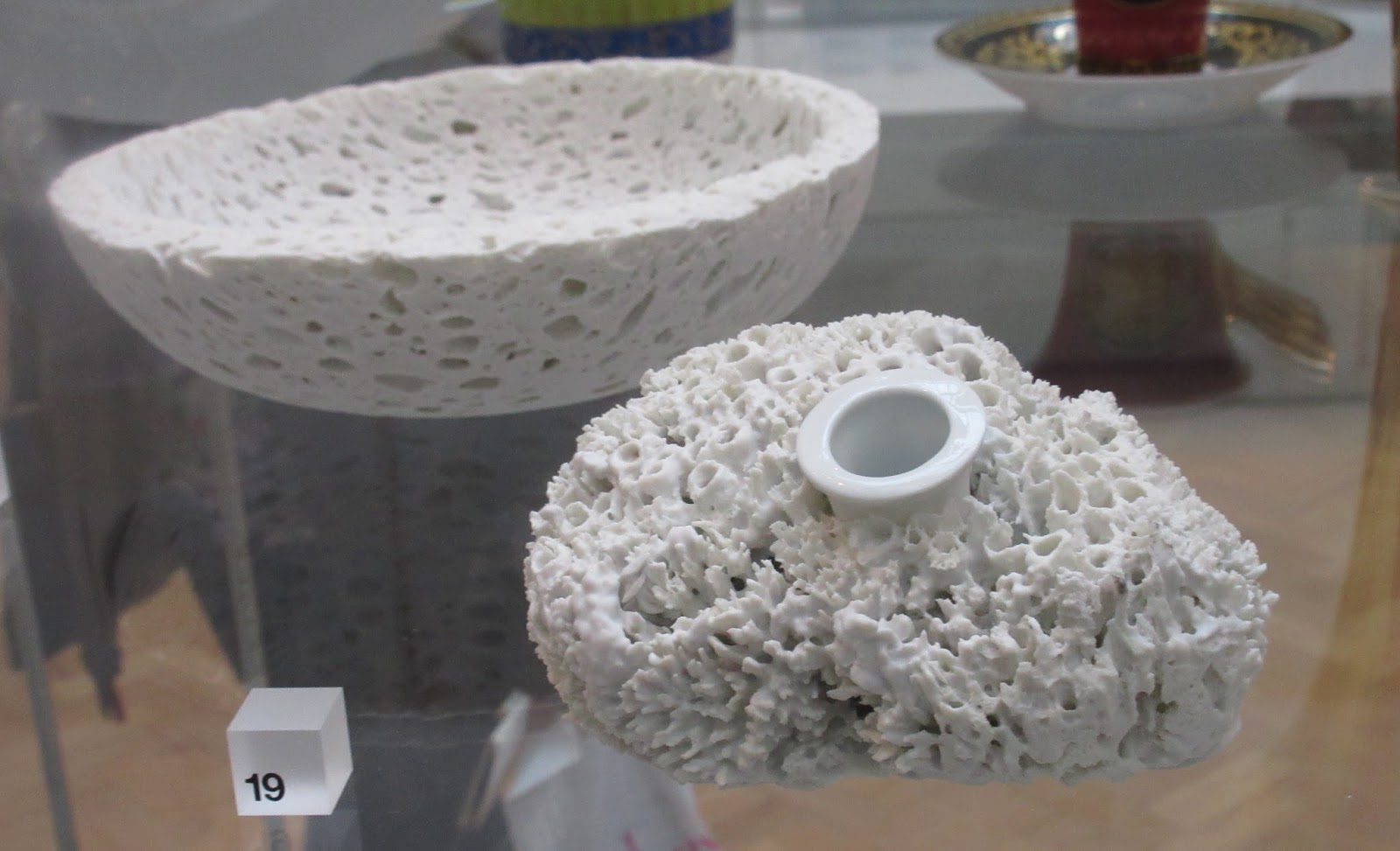
 I visited the ceramics department of the Victoria and Albert Museum to source ideas. I started by studying how designers made tableware representing other objects, such as swans, snakes, cauliflowers and asparagus. (Please excuse the poor quality of the snaps below, they were never intended for publication.)


But the objects that appealed to me the most were simpler, in particular a beautiful porcelain moon jar by Park Young Sook (2006) – the refined clay with its translucent, flawless glaze seemed to evoke the same pristine beauty many people associate with the Arctic. Moon jars were used as ritual vessels in South Korea during the Chosun period. What was I embarking on, if not a ritual? I don’t want to reproduce my photo here because it doesn’t convey any of the awe I felt looking at the moon jar, but you can view it in the online V&A catalogue.

Knowing I’d never achieve the smooth perfection of Park Young Sook’s vessel, I started to look at other textures, such as...


... Egg Vase (above), Foam Bowl and Sponge Vase (below), designed by Marcel Waanders for Droog, in collaboration with Rosenthal. (Made by Moooi. Amsterdam, The Netherlands, 1997. Unglazed porcelain, cast from hard boiled eggs inside a condom, artificial foam and a natural sponge.)


... and Omenanlohko (made by Gunvor Olin-Grönqvist at Arabia, Helsinki, Finland, 1986. Glazed stoneware.)

Finally, I looked at ceramics that included text. Nushu (below, 2006) by Sara Radstone is an evocative series of stoneware slabs, painted with slip and grey stain. 


Nushu is a script used to write a local dialect of Chinese spoken in Jiangyong County in Hunan. It was used exclusively by women, and translates as ‘women’s writing’. It developed as a form of private communication, sometimes embroidered onto fabrics or written on fans. Radstone’s text, written lightly and upside-down across a series of book-like forms, reflects the clandestine nature of the script...

...and far less subtle, but just as fascinating, this piece of French tableware which wittily mixes verbal and visual signifiers.


I also loved this early nineteenth century gilded plate, with its bobbly enamel sea urchin that –entirely coincidentally – is not so very different in appearance from my own finished piece.

In the end I chose to use a material much less ambitious than ceramic, and closer to my usual medium: papier-mâché. The cause of my return to paper was spotting a work by Chun Kwang-young in the museum. Aggregation10-SE032RED (2010, below) is composed of many hundreds of pieces of Styrofoam, individually wrapped in pages of books printed on hanji paper. Hanji has multiple uses in Korea – including wrapping household objects for storage. The surface this work is full of cracks and imperfections, and you can’t make out the original meaning of the texts. The curator writes: ‘These complex defects symbolise the difficult history of Korea, but the strong paper reflects the resilience of the Korean people.’ 


I liked the idea of taking apart a printed object to make the drum, which tied in with The Polar Tombola’s movement from the dictionary page to performance. Papier-mâché takes several days, as the thin strips of newspaper are dipped in an adhesive made of flour paste and applied over each other in a rough wove. There needs to be drying time between each application, and then a number of coats of white emulsion paint. The time it took to construct the two hemispheres of the drum gave me plenty of time to reflect on the process. As I covered one thin strip over and across another, current news stories disappeared under the damp paper and film of glue. It was a word-vessel made out of words. Slowly the object began to form, just as in the Arctic the gradual accretion of ice crystals, at first barely perceptible, becomes a solid layer over water. I thought of the Greenlandic words the drum would hold. One of these ‘amissaq’, has the dictionary definition: ‘boat skin, fish skin used for straining coffee’. I remembered the many new skins and surfaces I encountered in Greenland: permeable and impermeable, containing and protecting. 

I enjoyed making the papier-mâché drum enormously, the wordless activity being a respite from some of the intensive writing I’d been doing. I liked the rough edges of each hemisphere where they were pulled off the mould – this tied in nicely with the casual ‘village hall’ aesthetic of the project as a whole (as suggested by Small Publishers Fair director Helen Mitchell). Now that the snowball has travelled with me around the UK for two years, those edges are a little rougher, and the snowball is once again empty of its words. 


Saturday, 25 February 2017

The Polar Tombola in Bristol


Catch the Polar Tombola on the final date of its UK tour! This spring the Tombola will be at Bristol Artists' Book Event, a highlight of the bibliophile's calendar. The exciting - free! - event on 1-2 April will see book artists from Europe and beyond gather to exhibit, perform and sell their work in Bristol's majestic Arnolfini. 

Join us to play The Polar Tombola and celebrate the launch of a new book The Polar Tombola: A Book of Banished Words, published by Bird Editions with contributions from artists and writers including Sarah Bodman, Vahni Capildeo, Will Eaves, Pippa Hennessy, Nasim Marie Jafry, Lisa Matthews, Phil Owen and Richard Price. 

Read a short interview with me about The Polar Tombola and  A Book of Banished Words on the Arnolfini blog

Saturday, 10 December 2016

Sun Beats Collective - Podcast


Nukúnguasik, who escaped from the tupilak
from Eskimo Folk-Tales by Knud Rasmussen (1921)

Sun Beats Collective (@sunbeatsco) have launched a new poetry podcast.

In the first episode of Under the Table hosts Sarah and Anna interview me about poetry and place, with the emphasis on the latter - and digressions via kayaks, qivittoq and tupilaks. There are poems from Andrew Fentham (who responds with panache to my challenge to write a sestina using the titles of Pet Shop Boys songs), Jane Yeh and - a new discovery for me - the work of minimalist poet Robert Lax.

I'm looking forward to the next episode already.

Sunday, 6 November 2016

New edition!


A new edition of How To Say "I Love You" In Greenlandic has just been launched by MIEL books.

The new edition beautifully captures the colour and texture of the pochoir prints in the original artist's book, with its twelve postcards digitally printed on 300gsm cotton card stock, and an essay on Greenlandic language and landscape in the accompanying booklet.

MIEL books are offering an introductory discount of 30% to customers buying the book before 14 November 2016 - just quote the code WELCOMETOGREENLAND when you visit the online shop.

Sunday, 25 September 2016

The Polar Tombola - News


The Polar Tombola continues its UK tour this autumn with the following dates:

At The Poetry Library, London on 16 October, as part of Southbank Centre Literature Festival.
The Polar Tombola will be open from 12:00 until 18:00 for the Poetry Library's annual Open Day, with the theme Living in Future Times. Hang around! There's a poetry reading in the evening (20:00 start), at which I'll present newly commissioned work responding to the library collections.

At The Polar Museum, Cambridge on 29 October, for Cambridge Festival of Ideas.
Drop in between 12:00 to 16:00 to play the Tombola in the atmospheric surroundings of the UK's best polar collections.

At the World Museum, Liverpool, on 20 November,as part of the Women Crossing Cultures / Being Human Festival.
Come and play the Polar Tombola between 14:00 and 16:00; I'll conclude the event with a reading of Arctic poems from my collection Disko Bay at 16:15.

All these events are free, no booking required.

Can't make the dates above? The Polar Tombola will be making its final appearance in Bristol on 2 April 2017. Watch this space for details...


Sunday, 1 May 2016

"How To Say 'I Love You' In Greenlandic" News

'A book that is not only beautiful but full of joy, love and quiet intensity.' 
- Oliver Clark, Collinge and Clark Rare Books, London


I'm delighted to announce that How To Say 'I Love You' In Greenlandic: An Arctic Alphabet is being reissued by MIEL books. This reformatted and updated version of MIEL's popular pocket edition (first published 2014) will be available in October.


Want to read more? Here's a blog post on ice and alphabets written for MIEL back when the first pocket edition came out. Or an in-depth feature article on the people behind my story, published in the Independent. And Saradha Soobrayen, poet and librarian at the Poetry Library in London, reviews the first MIEL edition here.

MIEL's first edition of How To Say 'I Love You' In Greenlandic sold out quickly; guarantee your copy and support this amazing small press with a 2016 subscription. Can't wait until October? There are still copies of the original deluxe edition available.

Friday, 8 April 2016

Spring reading: art writing


  • an essay on the work of Yael Brotman in Scaffolding, the catalogue accompanying the artist's exhibition at Loop Gallery, Toronto
  • a review of Nikolai Astrup: Painting Norway at the Dulwich Picture Gallery, in the Times Literary Supplement
  • a review of The Power of Paper: 50 Years of Printmaking in Australia, Canada and South Africa at the Museum of Archaeology & Anthropology, Cambridge (catalogue edited by Nicholas Thomas) in Printmaking Today
  • I interviewed artist John Abell on his dramatic woodcuts created as part of a residency at Castell Coch, Wales, also for Printmaking Today (see below)


Thursday, 24 March 2016

New book: Death of a Foster Son


I'm pleased to announce the publication of Death of a Foster Son, an investigation into the eerie correspondences between polar bears and their human counterparts. The essay, first published in Zoomorphic magazine last year, is now available as a limited edition pamphlet, hand-sewn and numbered. The design - in which close readers will notice clues to the narrative - is by Roni Gross.

Death of a Foster Son explores the uncanny point at which the lives of bears and humans meet. The text merges two Arctic stories: a contemporary encounter with a polar bear in Upernavik, Greenland, and a traditional Inuit folk tale 'The old woman who had a polar bear for a foster son'. The illustrations, cyanotype collages created during a residency at Ilulissat Kunstmuseum in Greenland, are based on traditional catch-share diagrams and clothing patterns.

More information and available to order here.


Wednesday, 9 March 2016

Disko Bay - "hints of longing and foreboding"


Bookslut has been a favourite litblog of mine since it was founded fourteen years ago. So my gratitude to find a review of Disko Bay by poet Kali Lightfoot in the March/April issue was tempered by some sadness to read that the next issue, out in May, will be the last. (Happily, all the archived reviews and interviews will be accessible even after the Bookslut stops posting.)

Tuesday, 16 February 2016

A "bewitching" book


Many thanks to David Borthwick for his review of Disko Bay published in The Island Review.  Read it in full here.

Monday, 8 February 2016

Proviso

proviso

This is the text of the talk I gave at the launch of proviso 
at the Small Publishers Fair, London, on 6 November 2015
More information on proviso here


In 2010 I travelled to Greenland. I ended up leaving a word behind there. I’ve tried to get through the last five years without it. It’s a common word, without an obvious alternative, so occasionally I have to reorder my sentences in a convoluted manner to get around the fact it’s not there any more.

Why do this? Partly, it was a promise I had made. Before I left the UK I stayed with my good friends Frances and Nicolas McDowall who run the Old Stile Press in the Welsh Borders. It was December, and snow fell until their house was surrounded by deep snowdrifts. We joked that it was probably unnecessary for me to go to Greenland - there was enough ice and snow on our doorstep. It was like the trial runs polar expeditions used to go on: I practised all the activities I had planned for the Arctic, such as writing in the snow with maple syrup, and allowing the lines of sugar to harden into candy. When I finally left Frances and Nicolas inundated me with things I might need on my travels. I don’t remember when they concocted the scheme to give me a word to take away with me. Perhaps over a glass of Campari by the fire in the evening.

This word had been letterpress printed at the press several years before as part of a commission: a keepsake for a grand dinner held by a major media organisation. It is a beautiful piece of typography, though modest in size. But after printing was complete, the organisation changed its strategy, and the McDowalls were left with a large edition of these words, which lay forgotten in their attic.

Anyone who has trained as a letterpress printer or typefounder, who has cast type from molten lead, tin and antimony, and then set and printed it by hand, will understand how language begins to grow concrete in the process. I have often adapted my texts according to the number of sorts I had in the typecase, for example. In Greenland, by contrast, my experience of language was the reverse of physical. This is an oral culture, where for many years words were passed on in songs and stories, and never written down. As a writer, I found this historical lack of textual authority challenging. The original Danish missionaries did too: when they came to Greenland in the 18th century they introduced printing, despite the problems presented by using ink in freezing temperatures. But does printing ensure a language’s survival? Soon Danish was the first language of the nation, and by 2010 West Greenlandic was accorded vulnerable status on the UNESCO Atlas of the World’s Languages in Danger.  

In Upernavik I got to thinking about the English words I had, valuable words to me, that were useless in Greenland, and thinking about the words that the Greenlanders were using. I began to gain a few Greenlandic words and I realised if I stayed there long enough I’d probably lose some English ones.

In Greenlandic a single word can express concepts that other languages tiptoe around with a phrase. I was delighted to discover that on waking up in the morning I could say nuannarpoq rather than ‘I am full of a delirious joy in being alive’. Or illisiverupa, which means ‘to put something away in a safe place and be unable to find it again’. As I grew accustomed to densely-woven Greenlandic, with its small alphabet of only 19 letters and polysynthetic words, I began to find English finicky and prim in contrast. As though they were knucklebones used in a game of dice, I shook up tiny English words and scattered them before my audience, having little influence on the score.

The Greenlandic language has always been haunted by absences. When spoken, the suffixes are uttered so softly that an untrained ear cannot hear them. Verbs accrue morphemes, while nouns tend to disappear. It was once customary to name people after objects, but since a taboo forbade reference to the dead, the favoured objects were repeatedly renamed. The original names/words were never used again. The power of such words is not diminished by their absence from the vocabulary.  

proviso documents an intervention I undertook at Upernavik Museum as part of my investigation of lost languages. A clause in my contract as Writer in Residence read ‘Visual artists must leave a work behind in the museum, but writers are not required to do so.’

This proviso irked me a little. I understood that it was merely a reflection of the lack of prestige accorded the written word in Greenland, the preference for visual media. Needless to say, it was liberating to be excused from producing any work during the residency. However, it seemed strange that I should be exempted on account of working with language, when the Greenlandic language had proved such a rich resource for me. It set me to wondering how I might circumvent the rule and leave something verbal behind. Something not too obtrusive, something that no one would have to read. (I was thinking of the environmental caveat - variously attributed - ‘take nothing but memories, leave nothing but footsteps’.)

So I decided to leave behind just one word. Luckily I had a manifestation of language handy, in the form of the printed fragment created by Frances and Nicolas! I decided to not only leave the paper behind, but also excise the word from my language, so that I would never be able to use it again. It is a word on which future actions depend, so it is relevant to a place where decisions are being made that may change the fate of the globe. Climate change for example, or isolated events, like the recent, controversial proposal for a uranium mine in South Greenland. Of course, the word also features in a famous English poem.


It was to the Greenlandic dictionary that I turned as a custodian, leaving the word between its pages. Greenlandic has a long tradition of adopting loan words so I like to think my insertion will be welcome. Of course, that word was only one of a large edition printed by Frances and Nicolas. Perhaps it was the weight of all these unwanted words that led me to create the artist's book proviso as a record of the intervention. My own vanity likes the idea of leaving things behind too much.


Photographs (c) Peter Abrahams / Lucid Plane

Saturday, 9 January 2016

Words for Winter: forthcoming events


Wood engraving by Thomas Bewick

Words for Winter

Welcome to the Albion Beatnik, for a hearty evening of cold poems from Theophilus Kwek, Michael Loveday, Lucy Newlyn, Lavinia Singer, Andrew Smardon and Kate Venables. I'll also be reading from - and launching - my poetry collection Disko Bay (available from Enitharmon Press).

The Albion Beatnik, 34 Walton Street, Oxford, OX2 6AA
28 January 2016
7pm for 7.30pm start
Entry £2 on the door; refreshments available.

*

Eco-Poetry Evening

Readings by Nancy Campbell, Isabel Galleymore, Sophie Herxheimer and Nathan Thompson.

Academy of Music and Theatre Arts, Penryn, Cornwall, TR10 9LX
27 January 2016
6pm
Free, book tickets here.

*

Poles Apart

I'm excited to be reading with poet and novelist Will Eaves at the legendary London bookshop.

Gay's the Word, 66 Marchmont Street, London, WC1N 1AB
3 March 2016
7pm
Entry £3 on the door, complimentary refreshments provided.

Monday, 21 December 2015

Freeze: Thaw


On the shortest day of the year, news of a feature created for the Northern Lights season on BBC Radio 3.

In Freeze: Thaw, producer Tim Dee and presenter Hayden Lorimer explore ice through the words of poets, explorers and physicians. Jen Hadfield reads her ode to a pre-natal polar bear and Nick Drake gives voice to an ice core. There's a wonderful rendition of the white bear passage (see below) from Lawrence Sterne's Tristram Shandy, and you can hear me read part of the Ruin Island sequence from Disko Bay.

Available on iPlayer in some locations: http://www.bbc.co.uk/programmes/b06s7drr


Monday, 23 November 2015

The Polar Tombola


‘This is the first time I’ve looked in a dictionary since my A-levels,’ confided a hipster, eagerly flicking through the yellowing pages of my Greenlandic-English dictionary.

The Astonishing Polar Tombola was operational over Friday 5 and Saturday 6 November at the Small Publishers Fair in Conway Hall, London. Helen Mitchell, the fair’s organiser, sees the venue as something of a ‘village hall for London’, and with that in mind I combined an austere arctic aesthetic with a vintage village fête look in designing the tombola.


Pete Kennedy and Catherine Polley play the Polar Tombola
Photograph: Caspar Evans / Small Publishers Fair

Tombola has its origins in the cold, dark months of the year. The game (which draws its name from the word tombolare, to tumble or turn a somersault) is inspired by the raffle played by Italian families at Christmas time, with symbolic prizes and candied peel. The Polar Tombola is likewise a game of chance, one that turns expectations upside-down, as participants are invited to pick a Greenlandic word from a giant papier-mache snowball, and discover its meaning. Players are rewarded with a Fox’s Glacier Mint rather than preserved Mediterranean fruit. 

Over the course of the fair around 100 Greenlandic words are taken from the snowball. Everyone is curious to discover the meaning of the unfamiliar word, which frequently demonstrates an eerie synchronicity with their circumstances. I begin to wonder whether I should have set up shop as a fortune teller instead...

The game is intended to highlight the fact that the West Greenlandic language (Kalaallisut) is vulnerable, according to the UNESCO Atlas of World Languages in Danger. Language is especially important in places suffering the rapid effects of climate change: how can non-native scientists hope to study the arctic ecosystem without access to the knowledge of generations enshrined in the languages of the region?

I encourage players who have picked out and learnt a Greenlandic word to leave behind a word from their own language. It’s a big commitment to vow never to use a word again (as exemplified in my book proviso), and some people decide not to play: a few punters object to such self-censorship, and others just can't decide which word to leave behind. I certainly give away more Greenlandic words than I claim English ones. While I’m secretly pleased that people want to break the rules, the notion of exchange is important to me. 

Abandoned words
Photograph: Caspar Evans / Small Publishers Fair

The words left behind make a fascinating collection, representing deeply-felt political ideologies, personal histories and aesthetic preferences. For example:

- A woman left the word describing the main symptom of her illness.
- Someone (not the hipster) left the word ‘hipster’.
- Someone left the word for loneliness in Korean.
- A conservationist who works with eels left the word ‘panda’.
- Someone left the word ‘war’.
- One printer left the word ‘bespoke’.
- Another printer left the word ‘giclee’.
- Most fittingly of all, one woman left the word for a remembered (but unheard) voice (‘as in one who is dead’) in Farsi.

Night falls, and the last word is left behind
Photograph: Caspar Evans / Small Publishers Fair


All these words are safely stored away, and will be compiled in a future catalogue on the Polar Tombola. Meanwhile, it is pleasing to think of Greenlandic words in circulation in the UK, with new ambassadors for the language such as artist Steve Perfect, who has been introducing London bartenders to that staple cocktail ingredient, kaggsuk.

Close of play
Photograph: Caspar Evans / Small Publishers Fair